

Movement intelligence for clinicians
Clinical-grade motion metrics, from any smartphone.
Kinetically quantifies gait, balance, and mobility with objective measurements — so clinicians can assess faster, document defensibly, and adjust the plan of care with confidence.
Free 15-day trial, no card required · Markerless capture · HIPAA-aligned, BAA available
Live capture00:12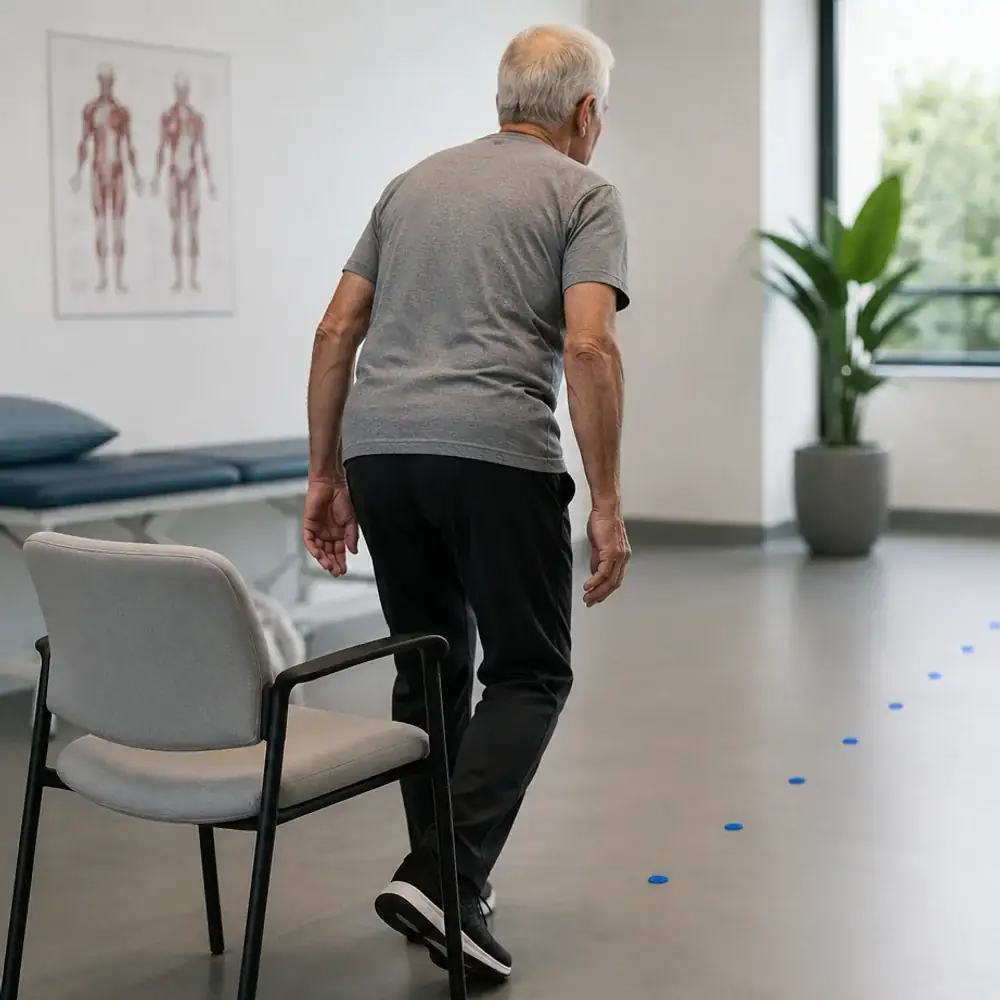
Built for the disciplines that depend on movement
Physical TherapyNeurologyMovement-disorder careGeriatrics & falls preventionOrthopedic recovery
Movement is one of medicine's most informative signals — and one of its least quantified. Kinetically turns it into objective evidence a clinician can act on, a payer can read, and a patient can see.
The platform
One continuous loop — measure, treat, document.
Not a single feature. The whole arc of a visit: capture an objective baseline, assign the care that should change it, and document everything along the way.
01Measure
Capture a standardized test in moments.
TUG, gait speed, sit-to-stand, postural sway, bradykinesia — recorded with a phone and scored automatically. No markers, mats, wearables, or manual stopwatch.
Explore measurements →02Treat
Assign the plan that should move the numbers.
Build a care plan from a curated library, push it to the patient's app, and track adherence and home-captured re-tests between visits.
Explore treatments →03Document
Notes that practically write themselves.
Objective metrics, baselines, trends, and adherence data flow into documentation in the language payers expect — and connect to the systems you already run.
Insurance & documentation →What you can measure
A broad, growing library of clinically meaningful tests.
Each test maps to the standards clinicians and payers already recognize — captured consistently across raters, visits, and devices.
See all measurementsGaitVelocity · cadence · step length · symmetry · double-support
BalancePostural sway · static & dynamic stability · functional reach
MobilityTimed Up & Go · sit-to-stand · turning · freezing of gait
Upper limbTremor · bradykinesia · range of motion · reach trajectory
CervicalRepositioning error · head tilt · range of motion
FacialSmile symmetry · post-stroke & Bell's palsy follow-up
1,200+
Body landmarks tracked in real time for full-body movement analysis.
15+
Standardized clinical tests, from Timed Up & Go to postural sway and bradykinesia.
0 new devices
Runs on the smartphones and tablets your clinic already owns — no lab, no procurement.

Where the value lands
Four things change when movement has a number.
The visit stays the visit. What changes is that every observation now comes with a measurement the next clinician, the payer, and the patient can all read.
- Assessments get faster and more consistent. A standardized capture replaces the stopwatch and clipboard, and every clinician gets the same number from the same movement.
- Progress becomes visible to patients and payers. Baseline-to-current comparisons make improvement legible to everyone in the loop.
- Documentation holds up to review. Timestamps, trends, and adherence data substantiate medical-necessity language and support RTM-ready workflows.
- Care continues between visits. Home re-tests and assigned exercises keep the measurement, and the patient, engaged until the next appointment.
Built for the people in the work
Different role, different starting point.
For clinic owners
Build the business case.
Efficiency, defensibility, retention, and RTM readiness — quantified with a configurable ROI model.
See the ROI model →For cliniciansThe visit, with the numbers.
The five-step assessment-to-care loop you already run, with the measurement and documentation pieces done for you.
See the workflow →Solutions by specialty
Designed around how clinicians actually work.
Clinical reference library
Reference material clinicians cite — free, sourced, and kept current.
Normative values, test protocols, billing codes and the research behind markerless measurement. Written for clinicians, cited to primary sources.
Reference values
Normative values & fall-risk cut-offs
Cited norms for gait speed, Timed Up & Go, sit-to-stand, balance, six-minute walk and grip strength — with the minimal change that counts as real.
Open →Test guideNine standard movement tests, explained
How each test is run, scored and interpreted — from the 10-Meter Walk and TUG to Berg, Functional Reach and MDS-UPDRS Part III.
Open →ReimbursementRTM CPT codes, 2026 quick reference
Every Remote Therapeutic Monitoring code with its data-day and time rules, billing frequency and who can bill — sourced to CMS.
Open →EvidenceThe research behind markerless analysis
Peer-reviewed studies on smartphone, markerless movement measurement — and where Kinetically stands on its own validation.
Open →ComparisonSmartphone vs. lab vs. wearables
A factual side-by-side of the three ways to measure movement objectively — hardware, setup, reproducibility, cost and reach.
Open →ROIRun the numbers for your clinic
An interactive model of the annual value of objective measurement: capacity, fewer denials, retention and RTM-ready revenue.
Open →News & Insights
All articlesLatest from the clinical team.
Clinical
The Short Physical Performance Battery (SPPB): How to Score It and What the Score Means
How to score the SPPB (balance, 4 m gait speed, five chair stands; 0–12), the official NIA cut-points, and what scores predict about disability and mortality.
ClinicalThe 10-Meter Walk Test: Protocol, Normal Walking Speeds, and Meaningful Change
How to run the 10-Meter Walk Test, normal walking speeds by age and sex from a 23,111-person meta-analysis, and how much change is meaningful.
ClinicalThe Functional Reach Test: Protocol, Normative Reach by Age, and Fall Risk
How the Functional Reach Test is performed, published reach values by age and sex, and what shorter reach suggests about recurrent-fall risk.
Built for the trust clinical data demands.
HIPAA-aligned by design, with encryption in transit and at rest, role-based access, and a privacy-first approach to patient movement data.
FAQ
Questions prospects ask first.
What is Kinetically?
Kinetically is clinical movement-analysis software that turns the smartphone or tablet a clinic already owns into an objective measurement tool. It captures standardized tests — gait, balance, mobility, tremor and upper-limb movement — with markerless computer vision and converts them into reproducible metrics clinicians can trend, document and defend. It supports, and does not replace, clinical judgment.
Do I need special hardware?
No. Kinetically runs on the smartphones and tablets your clinic already uses. There are no wearables, mats, markers or force plates to buy, calibrate or maintain.
Which tests and measurements does it capture?
Timed Up & Go, gait speed and gait variables (cadence, step length, symmetry, double support), five-times sit-to-stand, the movement-based Berg Balance items, postural sway, functional reach, range of motion, tremor and bradykinesia, among others. See the Measurements page for the full library.
How much does Kinetically cost?
A 15-day free trial of the full platform for one clinician, with no card required. Professional is $29 per clinician per month, or $249 per clinician per year. Enterprise plans for multi-location groups and health systems are custom-priced.
Is patient data protected?
Kinetically is HIPAA-aligned by design, with encryption in transit and at rest and role-based access control. A Business Associate Agreement is available for plans where one is appropriate.
Can patients be assessed at home?
Yes. Patients can complete short, guided re-tests and home exercises in the Kinetically app between visits, giving clinicians objective between-visit data that supports remote-therapeutic-monitoring workflows.
Get started
See movement, measured.
Start a free 15-day trial — no card required — and turn a smartphone video into objective clinical metrics in minutes.